The Moving Finger Writes: Using stop motion animation in the classroom to make poetry come alive
Audubon Gentilly 7th Grade - ELA & Visual Art
Andrea Panzeca
“I was that child with her finger running beneath the words until I was untaught to do this, told big kids don't use their fingers.In third grade, we were made to sit with our hands folded on our desk, unclasping them only to turn the pages then returning them to that position. Our teacher wasn't being cruel. It was the 1970s, and her goal was to get us reading not just on grade level but far above it. And we were always being pushed to read faster. But in the quiet of my apartment, outside of my teacher's gaze, I let my fingers run beneath those words.”
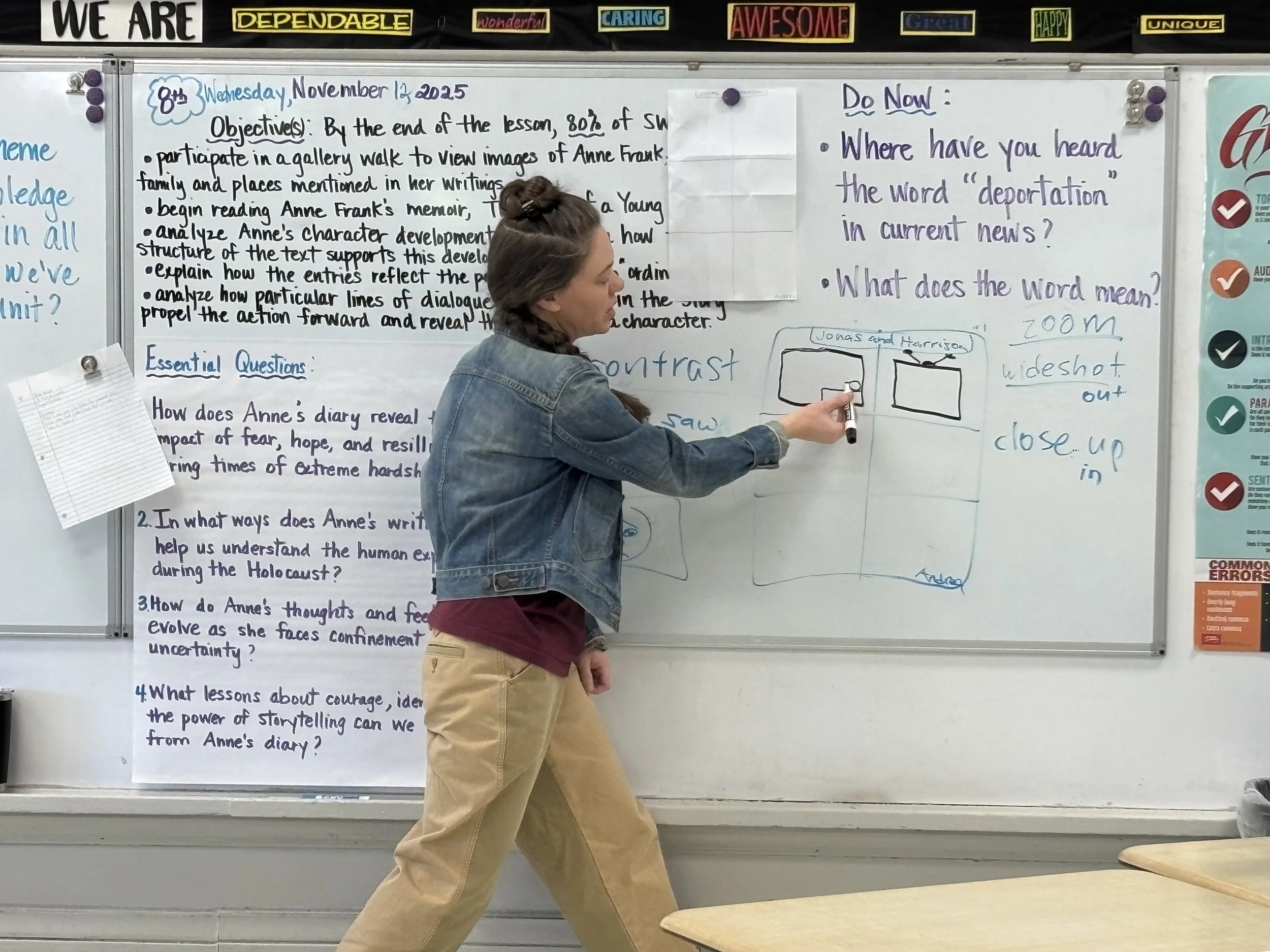
Students learned how words, images, and movement can work together to tell meaningful stories.
These words are from Jacqueline Woodson’s TED talk, which Ms. Lundy’s 7th grade students viewed before reading her book Brown Girl Dreaming. They were also the inspiration for Ms. Lundy and I when co-planning our arts-integrated lesson combining poetry and stop motion animation.
A memoir in verse, Brown Girl Dreaming contains Woodson’s memories of growing up in many poetic forms, including haiku. To deepen students’ learning, Ms. Lundy and I asked them to write haikus—inspired by Woodson’s memories and students’ own memories alike.
We then animated the haikus, using the stop motion technique of placing one word of the poem down, taking a photo, setting the next word down, taking a photo, and repeating the process until the whole poem was revealed.
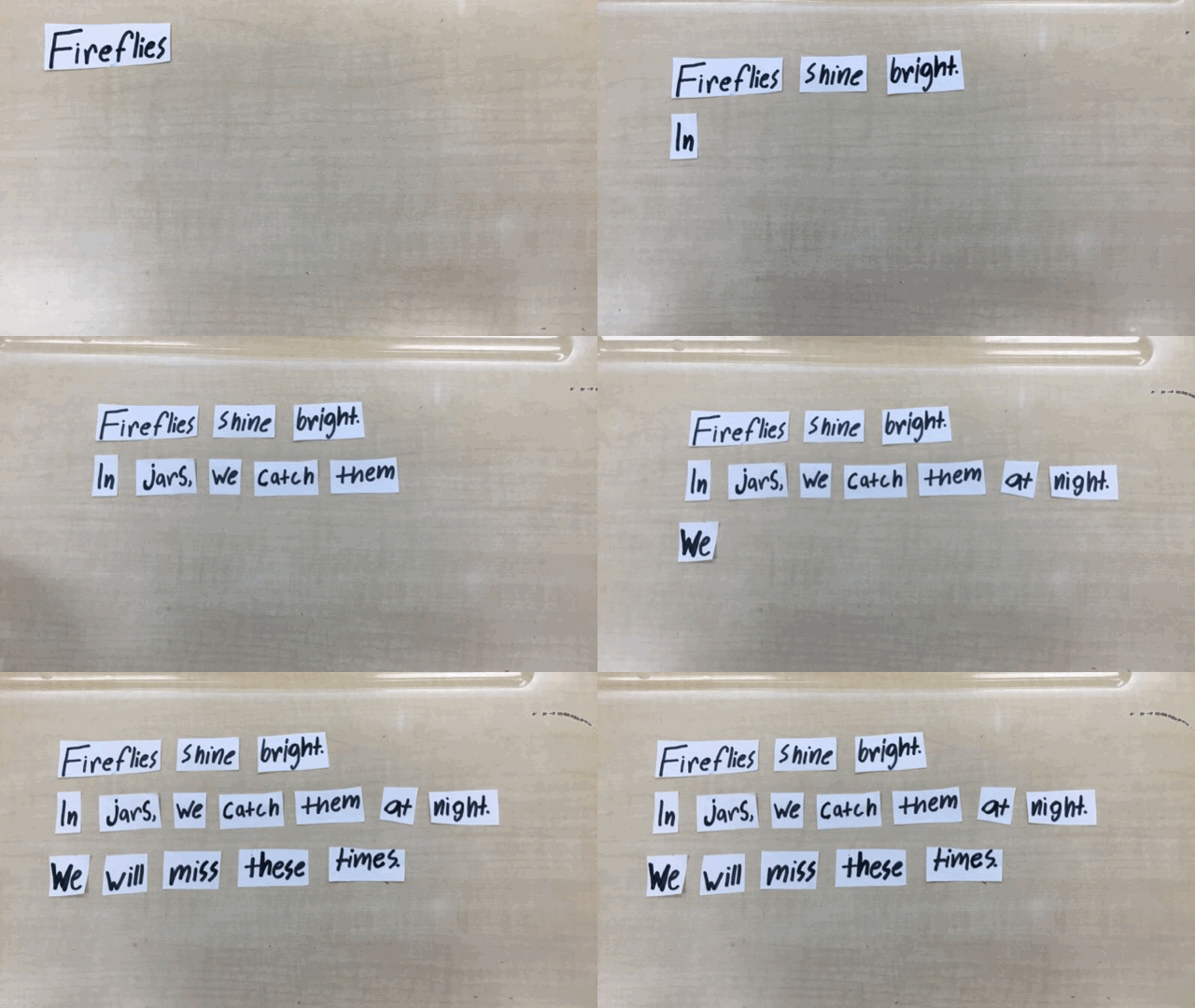
This student-created stop-motion haiku demonstrates the power of blending literacy, creativity, and visual arts.
In the resulting animations, the poems seem to write themselves. The animations remind the viewer that poetry is written and spoken, read and heard. The animations remind the viewer of Woodson’s own experience as a young reader she described in her TED talk, when she read slowly to savor every word.
Much like comics, an artistic approach Ms. Lundy and I employed throughout the year for students to demonstrate their understanding of the 7th grade ELA curriculum, stop motion animation is similarly versatile and cinematic. Both comics and stop motion use multiple frames or panels, making them well-suited to show sequence.
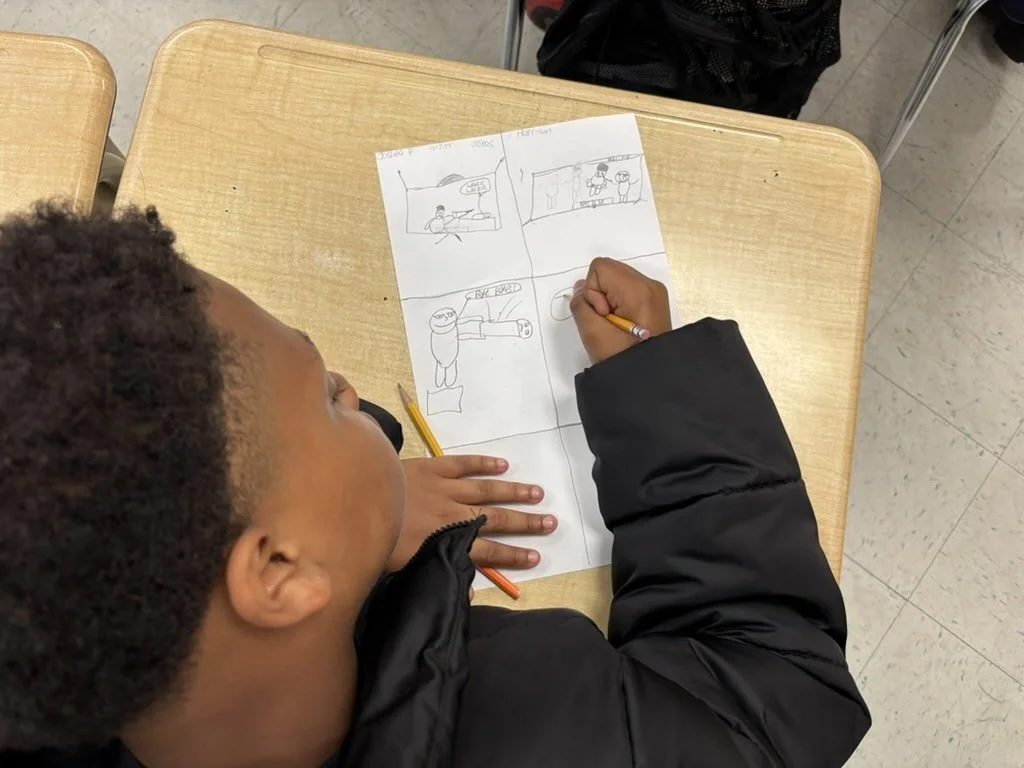
A student sketches visual storyboards while exploring cinematic storytelling techniques through arts integration.
In the fall, for example, when students were reading The Giver, we drew comics with varying camera zooms: we zoomed-out to show wide-shots of the setting in one panel, and in another panel, we zoomed-in to show a close-up of a character crying.
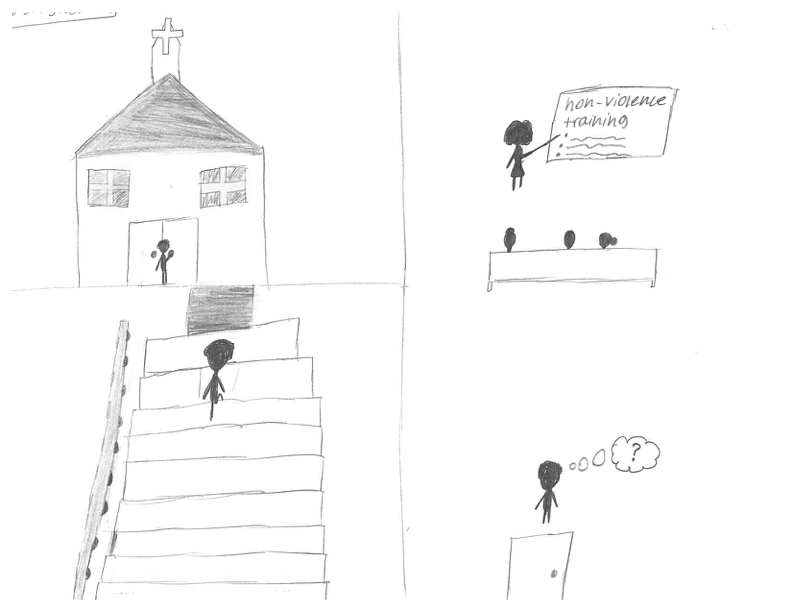
A students storyboard
Our comics lesson the week before we made stop motions was similarly cinematic. We read the poem “The Training,” which describes civil rights trainings that “take place in the basements of churches / and the backrooms of stores.” In a screenplay, the first word of every scene is either “EXT.” for exterior, or “INT.” for interior. In two-panel comics, we drew the exterior, a church or store, and in the next panel, we drew interiors featuring community members sitting together in front of a chalkboard, learning how to non-violently resist.
Having read “The Last Fireflies” the day we wrote haikus, many students’ animations were inspired by that poem. The poem depicts Woodson’s family; they “catch them in jars / then let them go again. As though we understand / their need for freedom.” A week after reading and illustrating “The Training,” the word freedom had a whole new context: not an abstract word, but a word denoting concrete plans of action with community members working together in church basements and business backrooms. A chalkboard and a list of action items.
Having learned so many cinematic techniques in comics throughout the year, it felt like a capstone to end with stop motion.
Although I grew up with computers, I would not say I’m particularly technically savvy. My first time using a QR code was only about three months ago. Yet, even with my limited skill set, I’m able to film, edit, and post videos of not only the students’ work, but my own instructional videos as well.
I always feel a tinge of pride when students are impressed that the Youtube video we are about to watch is mine. “You made this?!” and “Is that you?” they ask when they see my hands demonstrate inking, cutting, and labelling the backs of the words of my model haiku. I’ll never forget one student who, seeing that the video I made had not gone viral as he perhaps assumed most videos did, exclaimed, “One view?!”
Technical tips
I use the app Stop Motion Studio, then export the videos to iMovie. You could use a free online GIF maker, though there may be a watermark. You could also use iMovie directly, though it’s slightly more difficult (change duration of each photo to .1 second, and unselect the default “Ken Burns” scrolling setting)
You could get a tripod, wire rack, or stack of books; or just hold the camera
You can adjust the speed of the gif (frames per second), or duplicate photos if it moves too fast to be able to read. At the end of each student’s poem, I copied the final photo four times so it pauses in order for the viewer to finish the whole poem before moving on to the next poem
I combine the students’ poems in iMovie and remove transitions between clips so it doesn’t cut off the beginning or end of each poem